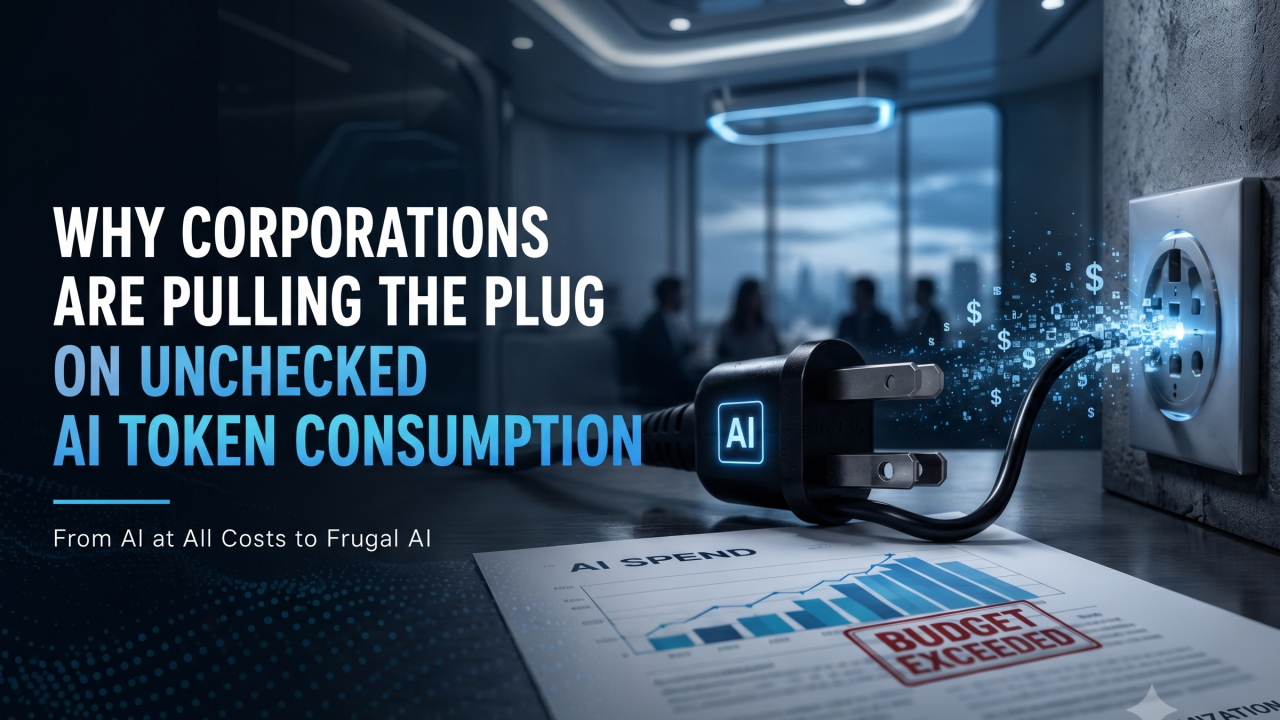
Token costs and "token maxing" have quickly become the talk of the town in recent weeks. In fact, corporations have already begun aggressively reining in their usage as the reality of unmonitored AI spend hits the headlines.
When generative AI exploded onto the scene, the corporate mandate was simple: adopt it at all costs. Businesses rushed to integrate large language models (LLMs) into every workflow, handed out enterprise AI subscriptions like candy, and gamified usage to encourage employee adoption.
But the bills have finally come due—and executives are experiencing massive sticker shock.
A recent report by Let’s Data Science, drawing on investigations from The Wall Street Journal, CNET, and Business Insider, reveals a major corporate shift. The era of unchecked, blank-check AI experimentation is officially over. Driven by skyrocketing token costs, major enterprises are transitioning from a philosophy of "AI at all costs" to "frugal AI."
At BaseRock, where we focus on business use case testing, we’ve had a front-row seat to this financial friction. Our work requires downloading large source code repositories, understanding complex architectures, and building deep context. We have seen firsthand how token consumption can spin completely out of control if not carefully governed. Once an engineering team starts heavily relying on advanced tools like Claude Code, Cursor, or Codex, a single engineer can easily rack up tens of thousands of dollars per month in usage fees alone.
Tokens—the fragments of words that LLMs use to process and generate language—are the basic currency of modern AI. When an employee asks an LLM a question, or when an AI agent runs a complex loop, tokens are consumed. If you aren't careful, those fractions of a cent compound at a staggering rate.
We are now seeing the fallout of unmonitored token consumption across tech giants and Fortune 500 corporations alike:
Early AI adoption focused heavily on lightweight, one-off chatbot interactions (e.g., "Summarize this email"). These are relatively cheap.
However, the industry has rapidly shifted toward Agentic AI—autonomous agents designed to execute multi-step workflows, write code, browse the web, and self-correct. Tools like Claude Code or advanced developer agents are incredibly token-intensive.
The real cost shock doesn't stem from the agent writing out final lines of code. It comes from loading large repositories repeatedly.
How an agent is guided completely dictates its cost profile. While many teams try to mitigate this by telling agents to limit their "read radius," the root problem lies deeper within the Agentic Architecture itself. Unless the system features a well-defined, centralized context layer, the agent will continuously crawl, parse, and search the repository over and over again, generating massive, redundant token overhead with every single execution loop.
Coupled with a recent MIT study of 350 deployments showing that 95% of AI initiatives failed to turn a profit, executives are asking a hard question: Are these massive token bills actually moving the needle?
The corporate response to token shock isn’t to abandon AI entirely, but to govern it with strict engineering and procurement guardrails. The industry is rapidly transitioning toward cost-optimized AI management.
If your organization is staring down ballooning LLM bills, here is how the world's leading engineering and platform teams are fighting back:
Why pay to process the exact same repository layout twice? By building a dedicated context layer between your code and the AI, systems can pre-index operational data and cache static segments of the codebase. Instead of an agent burning tokens to re-read thousands of lines of reference material on every loop, it pulls from the cache and targets its reads precisely.
Not every task requires a premium, frontier model. Tech leaders, including Salesforce CEO Marc Benioff, have heavily advocated for the deployment of "smart routers." These are orchestrators that evaluate an incoming query's complexity. A simple data extraction task or syntax check gets routed to a lightweight, inexpensive model (costing pennies per million tokens), while only highly complex, strategic reasoning tasks are escalated to expensive frontier models.
The days of handing out raw API keys are gone. Companies are building internal AI platform gateways that track token consumption at a granular, function-level layer. Engineers and departments are given strict token caps, and automated guardrails are put in place to terminate AI agents that get stuck in infinite, token-burning loops.
The corporate pullback on AI usage isn't a sign that the technology has failed; it's a sign that the technology is maturing. The "hype phase," where usage was celebrated regardless of cost, has officially collided with financial reality.
The future of engineering software isn't simply cheaper AI or bigger context windows. The future is AI tied directly to business outcomes.
At BaseRock, this is exactly why we focus heavily on business use case testing. When you ground an agentic workflow in validating actual business logic—rather than letting an unconstrained agent endlessly wander through a massive repository—the entire ROI equation flips. By shifting the objective from "write more code" to "verify this business outcome," you naturally force the agent architecture to be lean, targeted, and hyper-efficient.
Moving forward, the most successful AI implementations won't be the ones that use the most advanced models for everything. They will be the ones that master token efficiency—leveraging architectures that know exactly what to look for, achieving maximum business validation with the smallest possible token footprint.

Flexible deployment - Self hosted or on BaseRock Cloud