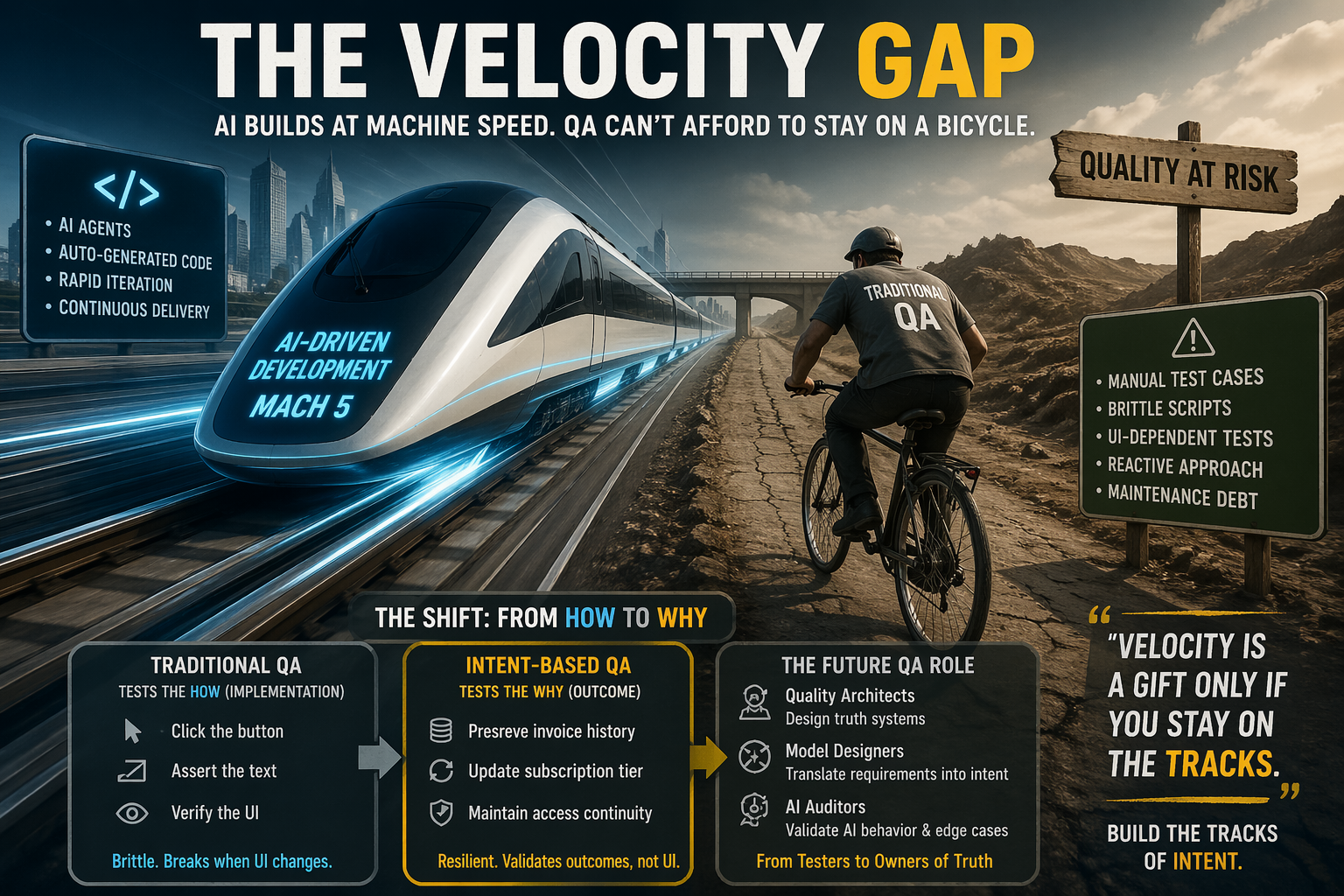
Imagine this: Your lead developer just used an AI agent to scaffold an entire end-to-end billing module in under four hours—a task that used to take three weeks of architectural meetings and manual coding. The code is clean, the PR is open, and the team is celebrating.
Then, the room goes quiet. Everyone looks at the QA lead.
The developer has just moved at Mach 5, but the testing process is still traveling by bicycle. To verify that four-hour sprint, a QA professional must now methodically author dozens of test scenarios, map them to selectors, and ensure no regressions were introduced. Suddenly, the "extraordinary gift" of AI-driven velocity feels like a looming landslide.
By almost every measure of development speed, we are living through a remarkable moment. But we are facing a hard truth: The bottleneck in the software lifecycle is no longer execution—it is the lack of a machine-readable model of product intent.
The natural response to an AI-speed problem is to apply AI as the solution. We’ve seen a wave of tools that autocomplete scripts or auto-heal CSS selectors.
While these are genuine improvements, they often function as "better typists." They remain anchored to implementation signals. If your tool is waiting for code to be written so it can suggest a test for a specific button, it is already behind. When development happens at machine speed, any human-in-the-loop validation of implementation details becomes a mathematical impossibility.
In many modern organizations, the dedicated QA role has been minimized in favor of developers owning the full lifecycle. But there is a psychological hurdle: a developer’s brain is wired to build, while a QA’s brain is wired to break.
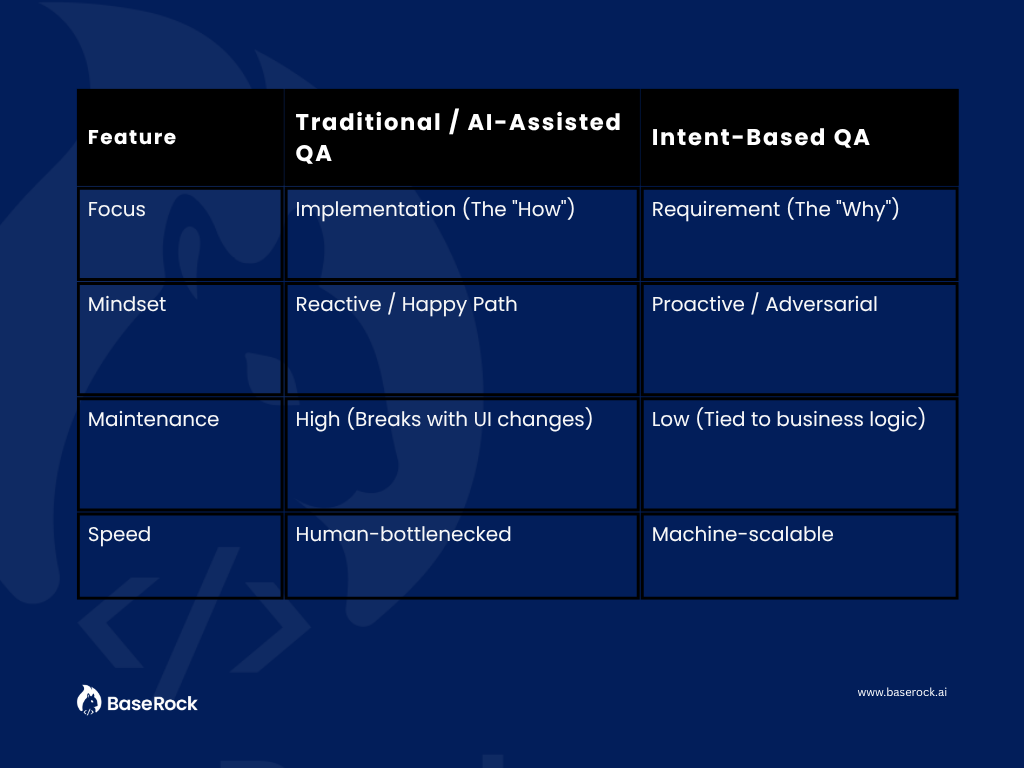
When AI accelerates development, this "Builder’s Bias" becomes a liability. Developers naturally write "happy path" tests to confirm their code works. They lack the time—and often the skeptical temperament—to spend hours imagining how a system might fail. The result? A mountain of machine-generated code protected only by shallow, optimistic tests. To move at "crazy fast" speeds, we cannot rely on developers to suddenly develop a skeptical mindset; we must automate the skepticism itself.
The philosophy of testing against business outcomes isn't new—BDD (Behavior Driven Development) has championed this for years. What is new is that AI-driven churn has turned "best practice" into "survival requirement."
Traditional automation is brittle because it tests the How:
The New Paradigm focuses on the Why (The Intent):
Requirement: “User can upgrade plan without losing billing history.”
Intent Model: >
1. Preserve historical invoice records.
2. Update subscription tier in the database.
3. Maintain uninterrupted session access.
In this model, the "test" is a machine-readable set of invariants. Whether the AI developer uses a button, a gesture, or a voice command to trigger the upgrade is irrelevant. The system validates the outcome across the API, database, and user journey.
We aren't suggesting a total abandonment of traditional scripts. The future of quality is a hybrid architecture where a System of Intent absorbs the bulk of regression validation, leaving lower-level tests as specific guardrails.
We must confront the reality that this shift fundamentally mutates the QA profession. The need for "manual executors" and "script maintainers" is compressing.
What goes away: Repetitive UI validation, writing brittle scripts, and "cat-and-mouse" regression fixing.
What grows: Quality Architects who design truth systems, Model Designers who translate ambiguous requirements into machine-readable intent, and AI Auditors who vet AI-generated behaviors for hallucinations.
The team of the future will be smaller and more technical. They won't be checking boxes; they will be defining the "invariants" of the product.
The extraordinary gift of AI development isn't just speed—it’s a forcing function. It is forcing us to move testing from the end of the factory line to the very blueprints of the product.
Velocity is only a gift if you stay on the tracks. Intent-based QA is how we build the tracks at the same speed we build the train.

Flexible deployment - Self hosted or on BaseRock Cloud

.jpg)