Open this article in your favorite AI assistant and get key insights instantly.
Introduction
In 2026, delivering software that simply works is no longer enough. Users expect products to feel intuitive, engaging, and emotionally satisfying from the very first interaction. This shift has led to the rise of vibe testing—a modern approach to quality assurance that evaluates not just functionality, but how users experience your product in real-world scenarios.
As release cycles accelerate and digital experiences become more competitive, vibe testing helps teams measure emotional engagement, usability, and overall product “feel.” At Baserock.ai, we see vibe testing as the next evolution of QA—where AI-driven insights complement traditional testing to build products users genuinely love.
What is Vibe Testing?
Vibe testing is a testing methodology that assesses the overall experience or “vibe” of a product. Instead of focusing only on pass/fail test cases, vibe testing combines:
Functional validation
Behavioral and interaction analysis
Subjective user feedback
Emotional and engagement signals
The goal is to understand how intuitive, enjoyable, and trustworthy a product feels when used naturally. A vibe test answers questions like:
Does this app feel easy to use?
Does the interface inspire confidence?
Do users enjoy spending time with this product?
Why Vibe Testing Matters
Traditional QA can confirm whether features work—but it often misses why users abandon products. Vibe testing matters because it:
Uncovers subtle UX friction that analytics can’t explain
Ensures products emotionally resonate with users
Improves satisfaction, retention, and adoption rates
Aligns development decisions with real user expectations
In competitive markets, the right vibe can be the difference between a product users tolerate and one they advocate for.
How Does Vibe Testing Work?
Vibe testing blends qualitative and quantitative techniques into a continuous feedback loop:
User Interaction Monitoring Track how users navigate, hesitate, or drop off during key workflows.
Emotional & Engagement Analysis AI models analyze behavior patterns, tone, and interaction flow to detect frustration, delight, or confusion.
Insight-Driven Optimization Teams refine UI, flows, and messaging based on real emotional responses.
Platforms like Baserock.ai enhance this process by integrating AI-powered analysis directly into automated testing pipelines—making vibe testing scalable and actionable.
Examples of Vibe Testing in Action
Mobile Apps: Testing whether onboarding feels smooth or overwhelming for first-time users
Websites: Evaluating intuitive navigation, clarity of CTAs, and overall engagement
Gaming Platforms: Measuring immersion, pacing, and emotional response during gameplay
SaaS Products: Understanding whether dashboards feel empowering or confusing
In each case, vibe testing focuses on how users feel while using the product—not just what they click.
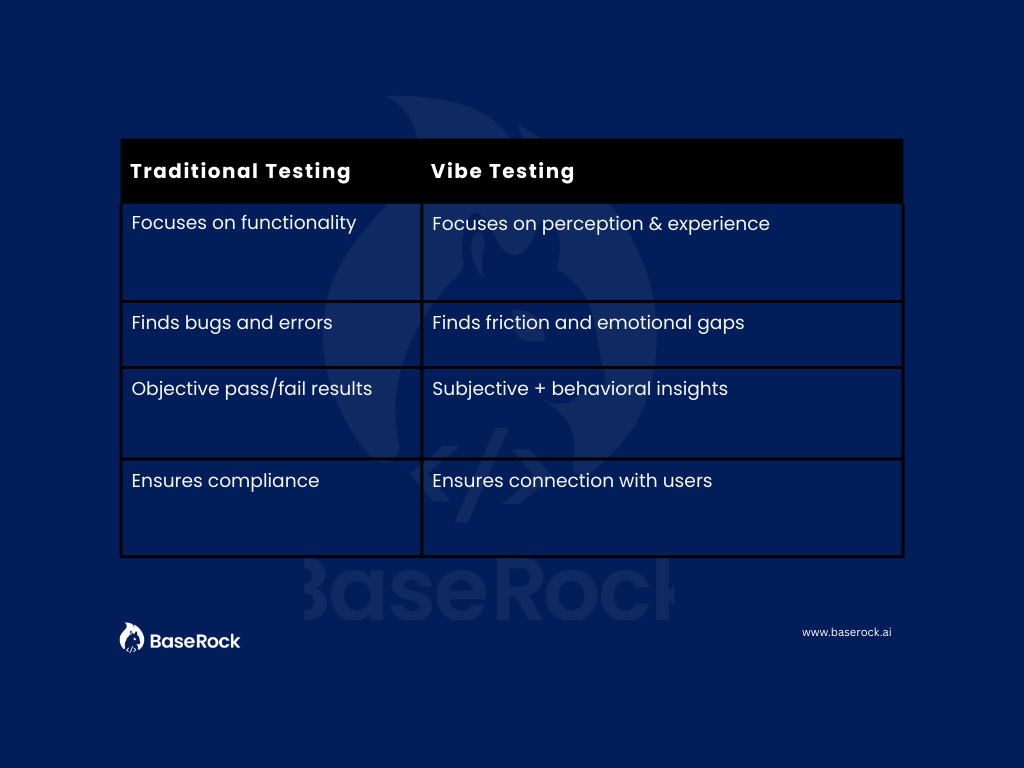
How Vibe Testing Differs from Traditional Testing
The most successful teams combine both. Functional QA ensures stability, while vibe testing ensures delight. Together, they deliver truly validated products.
Benefits of Vibe Testing
Key benefits of adopting vibe testing include:
Improved user satisfaction and trust
Early identification of UX and usability issues
Higher engagement and retention
Increased product adoption
Better alignment with real-world user expectations
With AI-driven platforms like Baserock.ai, these benefits scale across teams and releases—without slowing development.
The Future of Vibe Testing
The future of vibe testing is deeply AI-powered. Emerging trends include:
AI-driven emotion analysis to detect frustration or delight in real time
Predictive UX modeling that anticipates user reactions before launch
Integration with automated testing pipelines for continuous experience validation
Personalized experience testing based on user personas and behavior
As QA evolves, vibe testing will become a standard layer in modern software testing strategies.
CTA
Boost user experience with AI-driven vibe testing. Try Baserock.aitoday to create products that feel as good as they perform.
FAQ
What is vibe testing? Vibe testing evaluates how users emotionally and experientially perceive a product, combining usability, engagement, and behavioral insights.
How is vibe testing different from traditional software testing? Traditional testing focuses on functionality and defects, while vibe testing emphasizes user perception, emotional response, and experience quality.
Can vibe testing be automated? Yes. With AI-powered platforms like Baserock.ai, vibe testing can be automated and integrated into CI/CD pipelines for continuous insights.


.png)