Updates

The Testing Strategy in the Age of AI

Rishi Singh

March 31, 2026

For years, software development operated on a simple assumption:

Code is relatively stable.

That assumption no longer holds.

AI has fundamentally changed not just how code is written—but how it is rewritten, iterated, and replaced. And the data is starting to make this shift undeniable.

The Data: Code Churn is Rising

Recent large-scale analysis across hundreds of millions of lines of code shows a clear trend:

  • Code churn has increased from ~3% to ~5.7%
  • Copy/paste code is up ~48%
  • Refactoring (true reuse) has dropped from ~24% to ~9.5%

What does this mean in practice?

We are no longer primarily evolving code.

We are increasingly regenerating it.

The Hidden Impact: More Code, Less Confidence

AI has dramatically increased development velocity. But it has also introduced:

  • Higher duplication
  • Lower reuse
  • More short-term rewrites
  • Larger, noisier pull requests

The result?

We are writing more code than ever—but trusting it less than ever.

Why the Classic Testing Pyramid Breaks

The traditional testing pyramid assumes:

  • Developers understand the code they write
  • Changes are incremental
  • Tests can anchor to implementation

In high-churn, AI-assisted environments, these assumptions break down.

What fails first?

1. Unit Tests Lose Signal

Unit tests—especially when generated alongside code—tend to validate how something is implemented, not whether it is correct.

This creates a dangerous pattern:

  • Tests pass
  • Behavior is wrong

2. UI Tests Become a Maintenance Burden

UI tests are:

  • brittle
  • slow
  • tightly coupled to presentation

With frequent changes, they become a constant source of breakage, not confidence.

3. Code Review Becomes the Bottleneck

AI-generated code leads to:

  • larger diffs
  • more frequent changes
  • harder-to-review logic

Validation shifts from writing code → understanding and verifying it.

The Shift: From Code-Centric to Behavior-Centric Testing

In the AI era, correctness is no longer anchored to code.

It is anchored to behavior.

What matters is not how the system is implemented, but whether it:

  • behaves correctly
  • maintains business invariants
  • delivers expected outcomes

A Modern Testing Strategy for High-Churn Systems

To adapt, teams need to rethink testing at a foundational level.

1. Define Systems as Business Flows

Move away from testing individual functions.

Instead, define critical workflows:

  • User completes checkout
  • Payment is processed
  • Inventory is updated

These flows represent stable contracts that persist even when code changes.

2. Build a Business Flow Testing Layer

This becomes the foundation of your testing strategy.

Characteristics:

  • Runs at API or service layer
  • Validates end-to-end workflows
  • Independent of implementation

This layer provides:

  • high signal
  • resilience to churn
  • direct alignment with business outcomes

3. Elevate Integration Testing

With increasing duplication and reduced reuse, failures are more likely at system boundaries:

  • service-to-service interactions
  • data contracts
  • schema mismatches

Integration tests should be treated as first-class citizens, not a secondary layer.

4. Re-scope Unit Tests

Unit tests still matter—but their role changes.

They are best suited for:

  • core logic
  • deterministic computations

They should no longer be treated as the primary indicator of system correctness.

5. Minimize UI Testing

UI tests should be limited to:

  • smoke tests
  • a few critical user journeys

Most functional validation should move to:

  • backend
  • API
  • service layer

This improves:

  • speed
  • reliability
  • maintainability

The Double-Error Trap

One of the most overlooked risks in AI-assisted development is correlated failure.

When the same AI system generates both:

  • implementation code
  • and its corresponding tests

…it can encode the same misunderstanding in both.

The result:

A fully passing test suite that validates incorrect behavior.

The solution:

  • Generate tests from requirements and business flows
  • Keep validation independent from implementation generation

The New Testing Model

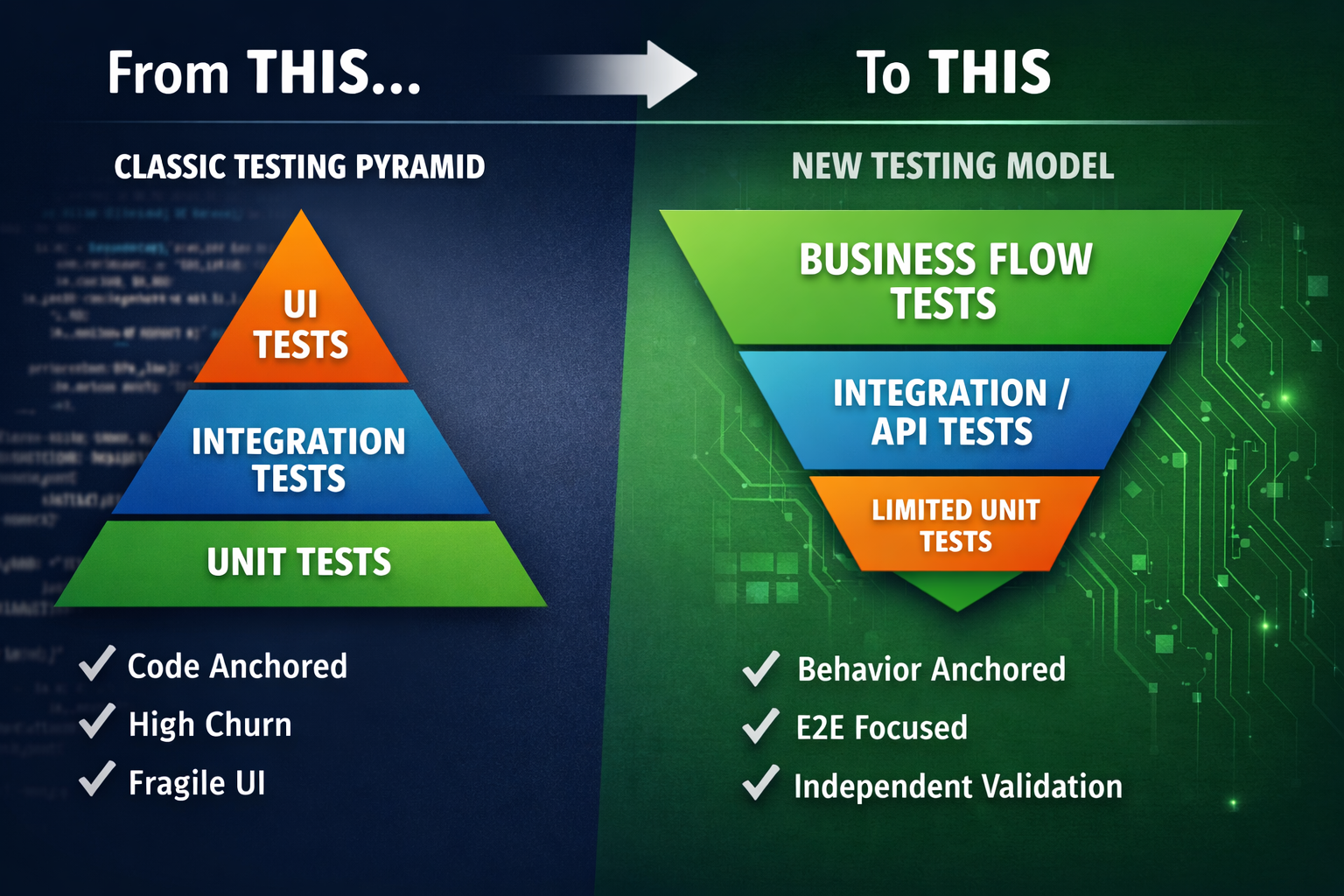
The traditional pyramid needs to evolve.

Instead of being code-centric, it becomes behavior-centric:

  • Business Flow Tests (Primary Layer)
  • Integration / API Tests
  • Selective Unit Tests
  • Minimal UI Tests (Smoke Only)

This model prioritizes confidence over coverage.

What This Means for Engineering Teams

The shift to AI-assisted development changes the core challenge:

From:

Writing correct code

To:

Verifying correctness in constantly changing systems

This requires:

  • higher-level abstractions
  • stronger alignment with business intent
  • independent validation mechanisms

Final Takeaway

Code churn has long been a signal of instability.

In the AI era, it has become a structural property of development.

Testing strategies must evolve accordingly.

In a world where code is increasingly disposable,business behavior becomes the only stable contract.

Related posts

Updates
December 22, 2025

API Contract Testing: Your Guide to Robust API Integrations with BaseRock.ai

Updates
September 23, 2025

Automated Functional Testing: A Complete Guide for Modern QA Teams

Updates
November 5, 2025

Autonomous Codeless Test Automation is redefining QA

Flexibility, Security, and Transparency with Baserock

Flexible deployment - Self hosted or on BaseRock Cloud