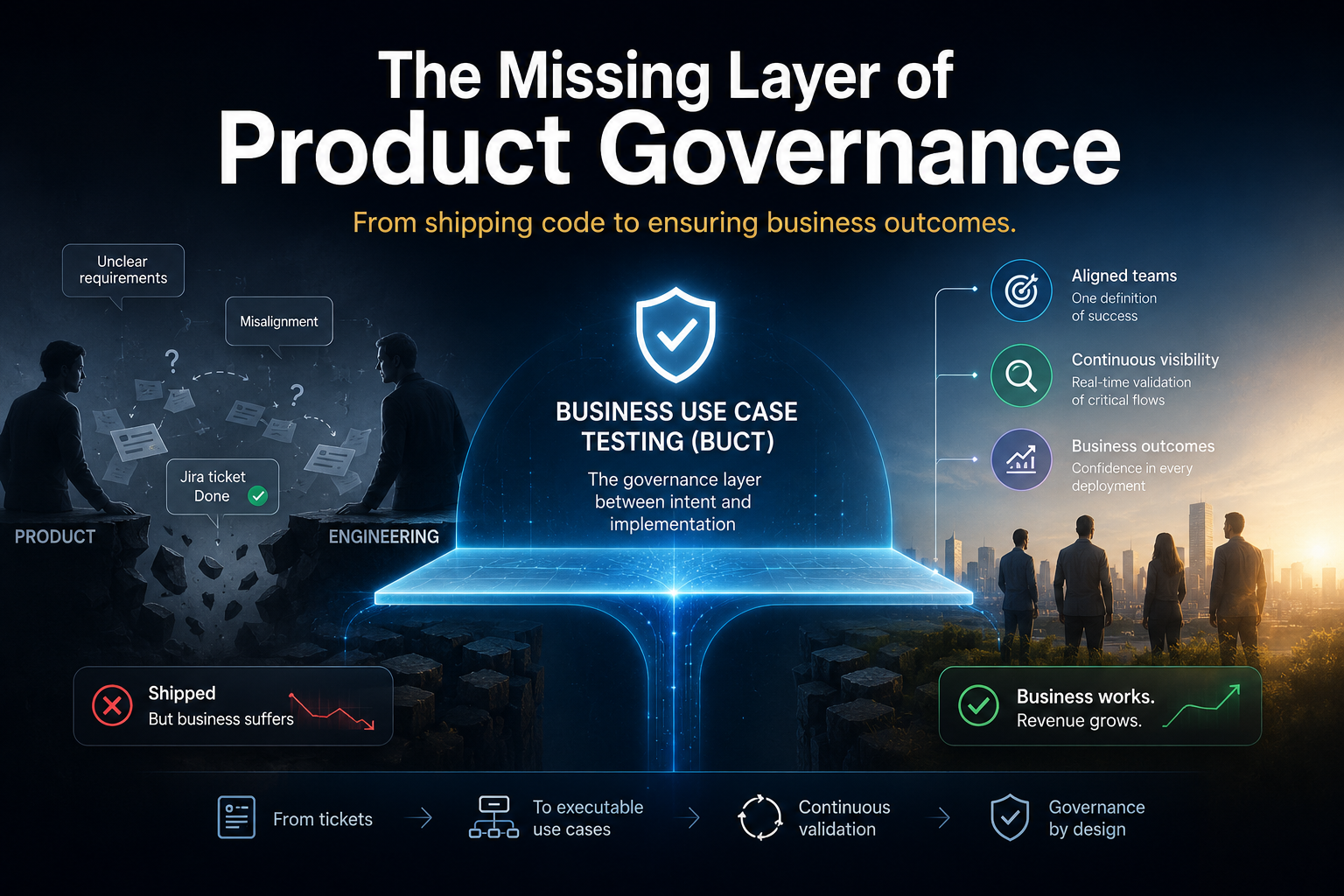
Friction between Product Management and Engineering is not new; it has existed since the earliest days of software development. Product managers define requirements, engineering interprets them, and somewhere in the middle, the original intent gets diluted. Most systems don’t fail in code—they fail in interpretation.
Often, requirements from PM teams are incomplete or ambiguous. Other times, they are perfectly defined but get overlooked during rapid implementation. Moving at breakneck speed, engineers may build something adjacent to what was intended, while QA cycles are compressed or skipped entirely.
This exact gap was a primary catalyst for the Agile methodology. But let’s be honest about its limitations: Agile solved communication frequency, not the semantic correctness of intent. It successfully forced teams to talk more often, but it didn't guarantee that what rolled off the assembly line actually matched the true meaning of the business requirement.
Yet, the problem persists. Even today, it is common to hear, “The Jira ticket is closed,” while key business requirements remain unfulfilled. The system says Done, but the business reality says otherwise.
In today’s development landscape, this alignment gap has become acute. AI-assisted development, rapid refactoring, and distributed engineering have exponentially increased shipping velocity. Code is no longer static—it evolves continuously. Engineers are iterating faster than ever, which is fantastic; the joy of modern engineering lies in rapidly shipping features that drive immediate value.
But this speed comes with a hidden cost: a total loss of visibility into whether the core business intent remains intact.
The uncomfortable truth of the modern DevOps era is that we optimized delivery speed before we solved delivery correctness.
At the center of most software applications sit a handful of critical flows that actually drive revenue and business outcomes—such as user onboarding, billing, account creation, transactions, and approvals. These flows are fragile, and minor, low-level implementation changes can silently break them.
The core question is no longer, “Did we ship?” but rather, “Did we build what the business actually needs?”
Business Use Case Testing (BUCT) introduces a structured, automated layer to ensure that business intent is never lost in translation.
When we launched BUCT, the goal was simple: ensure that the AI-driven rush in software development does not compromise core business functionality or introduce silent regressions. While the underlying tech stack has evolved, one truth remains: business outcomes depend on a small set of critical flows working flawlessly.
Traditional product development often suffers from abstract requirements. A single Jira ticket might represent a complex web of expectations, edge cases, and business rules, leaving it wide open to interpretation. Over time, this leads to a massive divergence between intent and implementation.
BUCT shifts this paradigm by translating abstract requirements into concrete, executable business use cases. Instead of a vague directive like “implement billing flow,” the system explicitly defines what that flow means through real user actions, system responses, and expected outcomes.
This transformation delivers two immediate advantages:
Traditionally, software governance has been a retrospective, check-the-box activity handled during late-stage audits, lengthy QA cycles, or post-release incident reviews.
BUCT shifts governance left, embedding it as a continuous layer of the software development lifecycle (SDLC).
Every critical business flow becomes a living specification. As the codebase changes, these flows continuously validate whether the system still behaves as the business intended.
This creates a real-time feedback loop between Product intent and Engineering execution. Instead of discovering gaps at the end of a sprint—or worse, via a customer support ticket in production—teams gain instant visibility into what changed and what is broken.
A common concern is whether adding a governance layer introduces friction to fast-moving engineering teams. In practice, the opposite is true.
By converting ambiguous requirements into structured business use cases, engineers spend less time guessing intent and more time building it correctly the first time. QA becomes highly focused, and product decisions become grounded in execution reality.
Ultimately, engineering velocity is preserved, while business confidence increases.
BUCT creates a shared language between Product Management and Engineering—anchored not in static documentation, but in executable business intent. It allows product managers to gain visibility directly from tools like Jira, while providing engineers with immediate feedback on their alignment with business goals.
We are entering an era where software systems change too rapidly for traditional QA validation to keep up. In this new world, the most critical question is no longer whether the code works in isolation, but whether the business still works after every deployment.
Business Use Case Testing represents a fundamental shift from testing code correctness to governing business outcomes continuously. That shift is the very foundation of modern product governance.
Q1: What is product governance in software development?
Product governance is the set of processes and controls that ensure software being built consistently reflects the original business intent — from requirements through deployment. It bridges the gap between what Product teams define and what Engineering actually ships.
Q2: Why do software requirements fail during implementation?
Requirements fail because they are often abstract, incomplete, or interpreted differently by engineering teams. Agile improved communication frequency but didn't solve semantic correctness — meaning teams talk more but still ship the wrong thing.
Q3: What is Business Use Case Testing (BUCT)?
BUCT is a structured, automated testing methodology that converts abstract product requirements into concrete, executable business use cases. It ensures that critical flows like billing, onboarding, and transactions continue to work as intended after every code change.
Q4: How is BUCT different from traditional QA testing?
Traditional QA validates whether code works technically. BUCT validates whether the business works - ensuring that the system still satisfies real-world business outcomes after every deployment, not just at the end of a sprint cycle.
Q5: What does "shift left governance" mean?
Shift left governance means embedding quality and compliance checks earlier in the development lifecycle rather than at the end. With BUCT, governance becomes a continuous layer throughout the SDLC rather than a retrospective audit.

Flexible deployment - Self hosted or on BaseRock Cloud

.jpg)