<script type="application/ld+json">
{
"@context": "https://schema.org",
"@type": "FAQPage",
"mainEntity": [
{
"@type": "Question",
"name": "Is sanity testing manual or automated?",
"acceptedAnswer": {
"@type": "Answer",
"text": "Sanity testing can be performed manually or through automation. However, automation—especially using autonomous testing platforms such as BaseRock AI—offers better speed, consistency, and scalability."
}
},
{
"@type": "Question",
"name": "How long should sanity testing take?",
"acceptedAnswer": {
"@type": "Answer",
"text": "Sanity testing usually takes a few minutes to a few hours. If it requires days to complete, the testing scope has likely shifted from sanity testing to regression testing."
}
},
{
"@type": "Question",
"name": "When should sanity testing be skipped?",
"acceptedAnswer": {
"@type": "Answer",
"text": "Sanity testing should be skipped when changes are large, complex, or architectural. In such scenarios, a complete regression testing suite should be executed instead."
}
}
]
}
</script>
Software evolves constantly — new features, bug fixes, configuration updates, and performance enhancements are pushed every sprint. But even minor changes can unintentionally break existing workflows. To ensure stability without running a full regression cycle, QA teams rely on sanity testing.
Sanity testing is a fast, focused validation step executed after recent code changes to ensure that key functionality remains stable. Instead of re-testing the entire system, sanity testing assesses the modules impacted by the latest update and confirms whether deeper QA testing can proceed.
It acts as a quality gate and answers a critical question:
Is the updated build stable enough for further testing?
Organizations implementing BaseRock AI use sanity testing as an early checkpoint to prevent unstable builds from consuming valuable QA time and delaying releases.
Sanity testing is appropriate when updates are limited in scope but may be disruptive. Typical scenarios include:
Because sanity testing is targeted and fast, it helps QA teams avoid deep test cycles on unstable builds.
Teams working with BaseRock AI commonly run sanity tests automatically after every pull request merge, ensuring ongoing build stability throughout development.
Sanity testing takes place:
If the sanity test passes, testing continues.
If it fails, the build is rejected and sent back to engineering.
Through CI/CD-enabled workflows, BaseRock AI can trigger sanity tests autonomously after each deployment, providing instant feedback without human intervention.
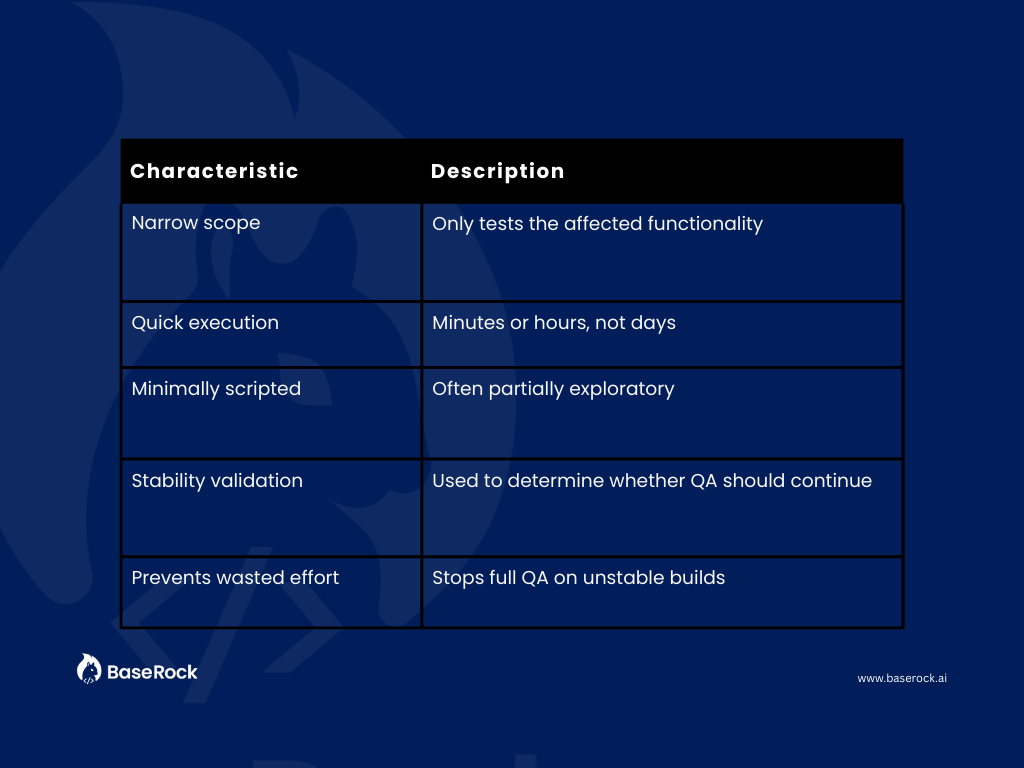
Sanity testing reduces delays, prevents regression overhead, and improves release confidence.
Common tools that support sanity testing include:
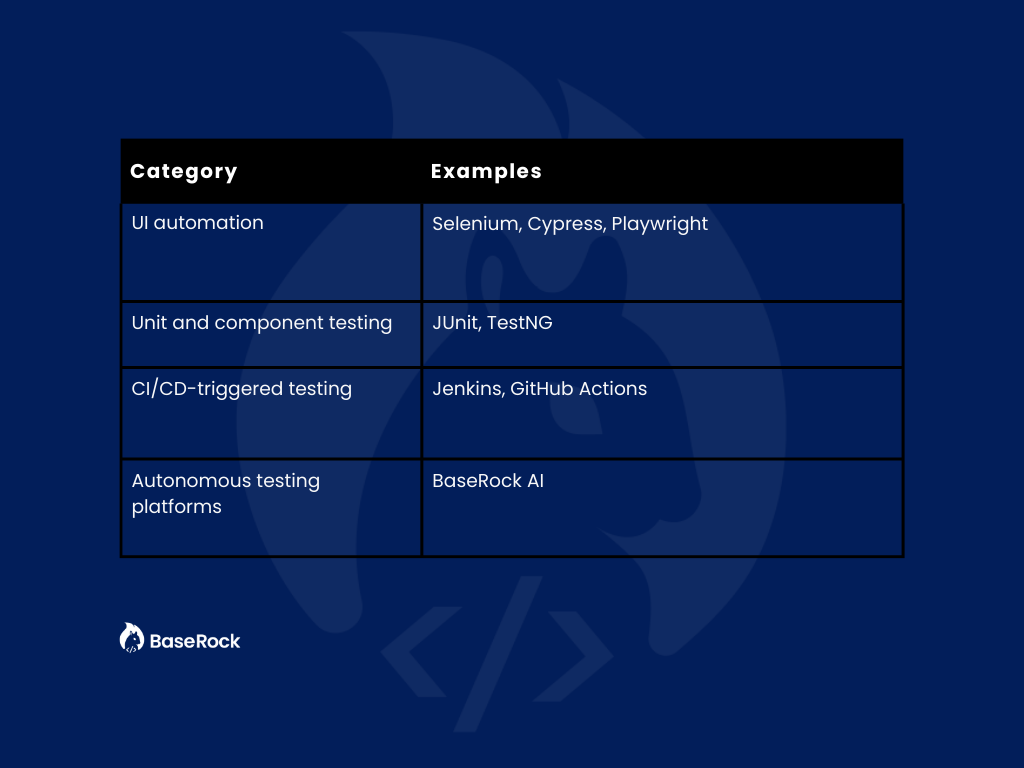
While traditional tools require manual script maintenance, autonomous platforms such as BaseRock AI significantly reduce the testing burden by automating test creation, execution, and continuous maintenance.
BaseRock AI is a modern software quality platform powered by autonomous AI agents that automate the entire testing lifecycle — including unit, integration, and functional testing.
For sanity testing, BaseRock AI delivers several key advantages:
Unlike traditional tools that simply generate test scripts, BaseRock AI applies an “agentic QA” approach, where AI agents autonomously plan, execute, learn, and optimize testing strategies — functioning much like virtual QA engineers.
To support enterprise security needs, BaseRock AI offers:
By automating repetitive sanity testing tasks and identifying defects earlier in the software lifecycle, BaseRock AI reduces QA costs and helps engineering teams ship features faster with greater confidence.
Sanity testing is a crucial checkpoint that protects software stability after incremental updates. It ensures that developers’ changes do not negatively impact core functionality and that QA teams do not waste time testing unstable builds.
With BaseRock AI, sanity testing becomes:
The result is shorter QA cycles, faster releases, and higher product reliability.
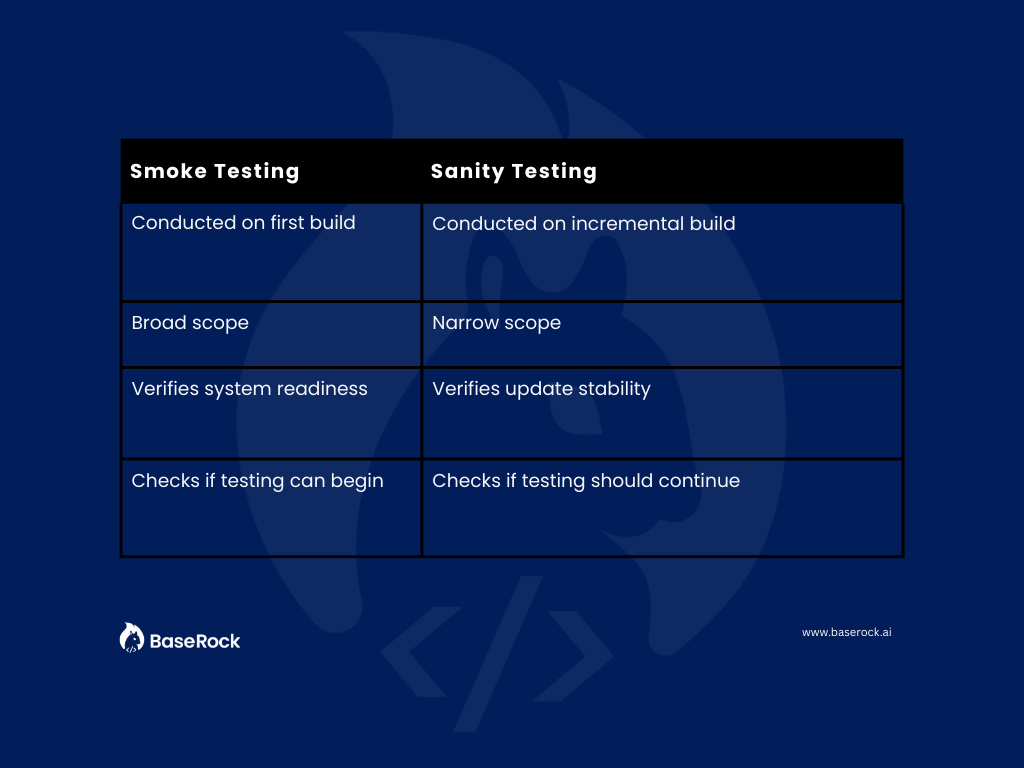
1.What is the main difference between sanity and smoke testing?
2.Is sanity testing manual or automated?
Both. However, automation — especially through autonomous platforms
such as BaseRock AI — ensures speed, consistency, and scalability.
3.How long should sanity testing take?
Typically between a few minutes and a few hours. If it takes days, the
scope has gone beyond sanity testing and into regression.
4.When should sanity testing be skipped?
Sanity testing should be skipped when updates are too extensive or
architectural. In such cases, a full regression suite is required.

Flexible deployment - Self hosted or on BaseRock Cloud