{ "@context": "https://schema.org", "@type": "FAQPage", "mainEntity": [ { "@type": "Question", "name": "What is the difference between QA automation and test automation?", "acceptedAnswer": { "@type": "Answer", "text": "Test automation focuses on executing scripts automatically. QA automation covers the entire quality lifecycle." } }, { "@type": "Question", "name": "How much does QA automation cost?", "acceptedAnswer": { "@type": "Answer", "text": "Costs vary by tool, scope, and team size, but automation reduces long-term QA spend." } } ] }
Modern software products move fast—and users expect them to be fast, stable, and flawless. Even a single defect can disrupt user experience and damage brand trust. That’s why high-performing engineering teams rely on quality assurance automated testing to deliver reliable releases at scale.
Rather than relying only on manual testers, organizations are now using automated QA strategies to accelerate delivery and reduce risk. Baserock.ai helps teams adopt and scale automation with proven frameworks, tooling, and workflows designed for long-term success.
BaseRock AI is a modern software quality platform that uses autonomous AI agents to automate the entire testing process — including unit, integration, API, and functional testing. Instead of writing and maintaining test scripts manually, engineering teams receive automatically generated, self-healing test suites that evolve as the code changes.
Quality assurance automated testing is the use of software tools and pre-built scripts to execute test cases without human involvement.
Instead of manually validating every feature and user flow, automated testing tools repeatedly execute scripts across browsers, devices, and operating systems—ensuring performance and functional consistency.
Teams partner with Baserock.ai to automate repetitive and time-intensive testing tasks, freeing QA engineers to focus on exploratory and strategic validation.
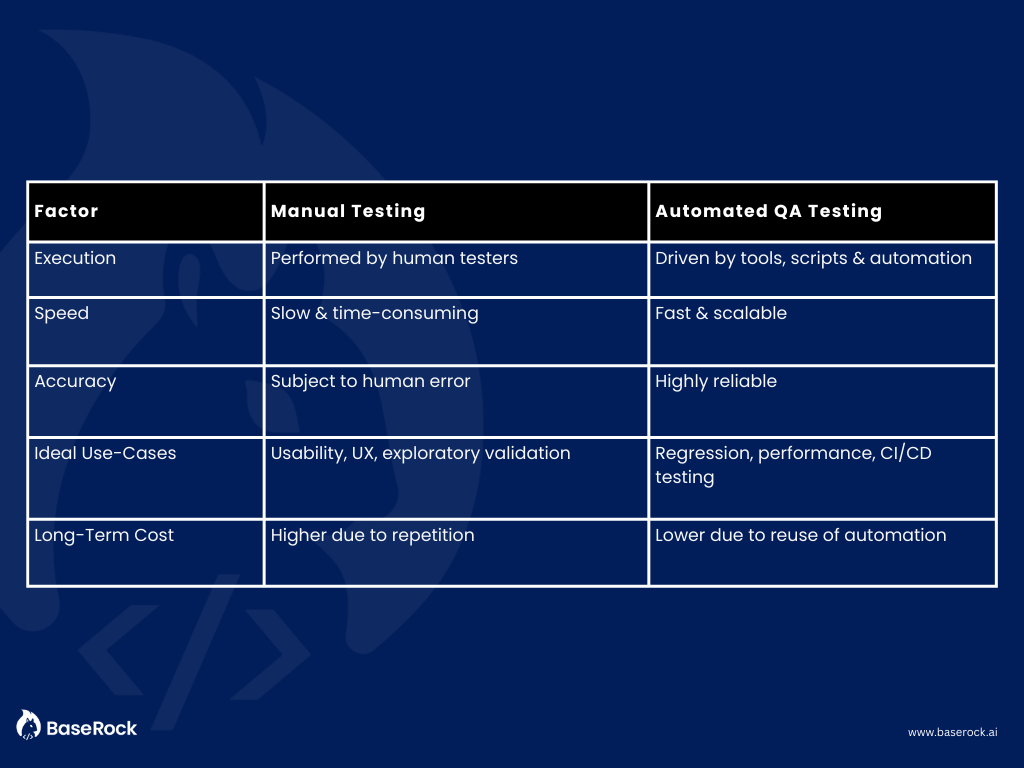
Manual and automated testing aren’t competing — they’re complementary. However, for products with frequent releases or complex functionality, automation provides massive long-term efficiency.
Automation doesn’t need to cover every scenario to be impactful. It is most beneficial in critical test categories such as:
Ensures that new features don’t break existing ones.
Measures system behavior under real-world stress.
Validates expected behavior across browsers and devices.
Confirms that components, microservices, and APIs work together reliably.
Organizations choose Baserock.ai because our frameworks are designed to prioritize these high-ROI areas first, ensuring faster automation success.
Automation works best when testing is:
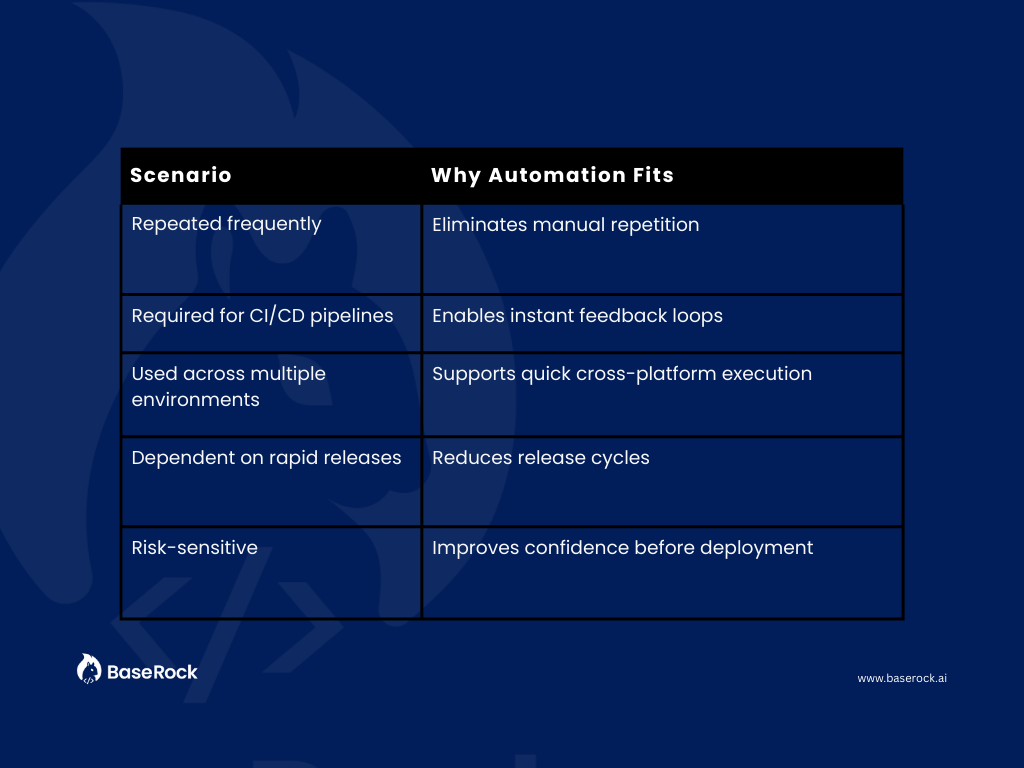
If your product updates weekly—or even daily—Baserock.ai helps build automation pipelines that keep up with development velocity.
A structured QA automation lifecycle includes:
Baserock.ai provides end-to-end QA automation implementation, including strategy, script development, CI/CD integration, and automation maintenance support.
Different QA automation needs require different tools. Some widely used tools include:
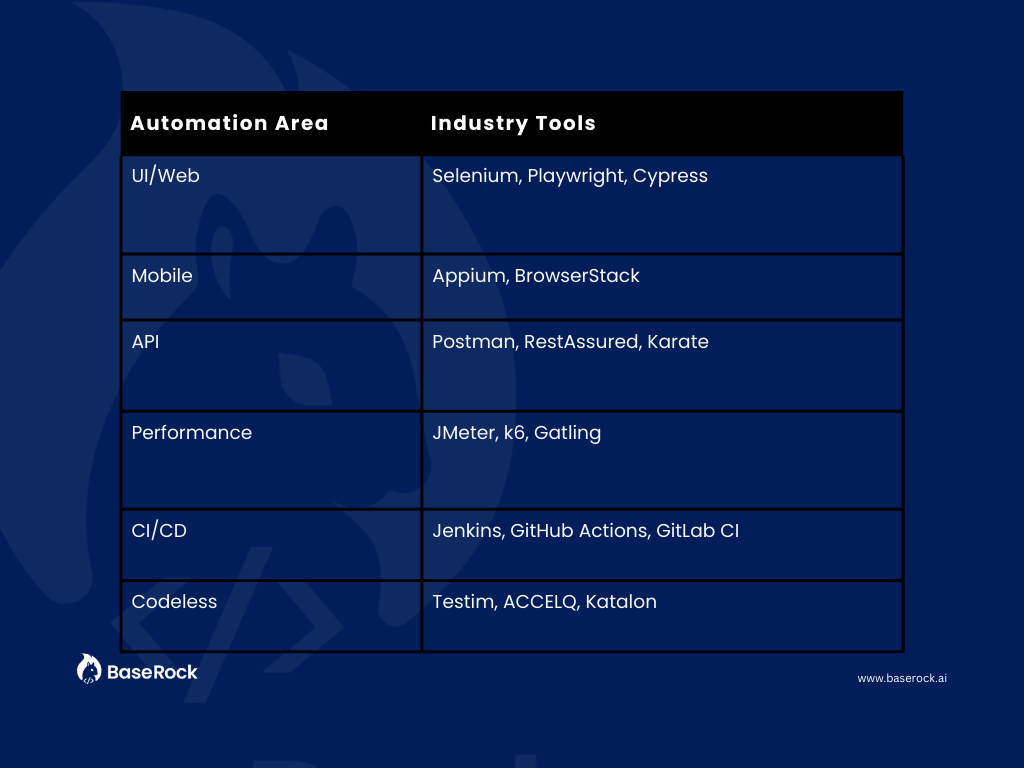
At Baserock.ai, we evaluate the tech stack, infrastructure, and testing maturity to recommend the best toolset—not a one-size-fits-all solution.
Engineering teams trust Baserock.ai because we make QA automation efficient, scalable, and future-proof.
With our automation expertise, proven frameworks, and seamless workflows, we help companies:
✔ Improve product quality and stability
✔ Reduce manual testing hours by up to 80%
✔ Expand test coverage without expanding headcount
✔ Release software faster with fewer defects
✔ Scale QA operations across large and distributed teams
Whether you’re modernizing your QA strategy or starting automation from scratch, Baserock.ai delivers a clear roadmap to success.
Work with automation experts who understand engineering velocity.
👉 Book a free consultation at Baserock.ai and accelerate your QA automation journey

Flexible deployment - Self hosted or on BaseRock Cloud

.png)