In the fast-paced world of software development, the year 2026 marks a turning point where "quality at speed" is no longer a luxury it’s a survival requirement. Traditional automation, while foundational, often buckles under the pressure of rapid UI changes and complex microservices.
This is where AI testing tools step in, transforming QA from a reactive bottleneck into a proactive intelligence layer. By leveraging machine learning (ML) and generative AI, these tools are helping teams boost efficiency by up to 85% while slashing maintenance costs.
AI testing tools are software solutions that leverage artificial intelligence and machine learning to automate, optimize, and enhance the entire software testing lifecycle. Unlike traditional scripted automation — which relies on rigid “if-this-then-that” rules — AI-driven systems use context-aware algorithms to:
In essence, these tools move beyond simply checking features — they understand application behavior and user flows, allowing test suites to adapt automatically as the software evolves.
While enterprise suites offer robust support, open-source AI testing tools (like Selenium with AI plugins or Playwright) are gaining massive traction in 2026. Their benefits include:
Adopting open-source AI isn't without its hurdles. In a professional environment, these factors can sometimes outweigh the "free" price tag:
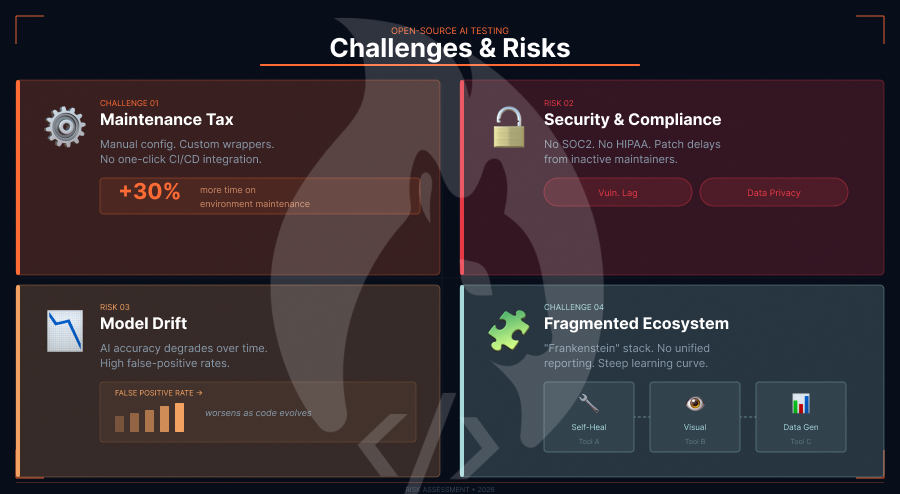
Open-source tools often require significant manual configuration. While an enterprise tool might offer a one-click integration, open-source AI often requires you to build your own "wrapper" or middleware to connect it to your CI/CD pipeline.
Key Stat: In 2026, teams using open-source frameworks report spending up to 30% more time on environment maintenance compared to those using managed enterprise platforms.
Open-source models may lack the rigorous security certifications (like SOC2 or HIPAA compliance) required by finance or healthcare industries.
While open-source allows for transparency, it doesn't guarantee accuracy. Without the dedicated R&D teams that enterprise vendors provide, open-source AI models can suffer from Model Drift—where the AI's "understanding" of your application degrades over time as the code evolves, leading to high false-positive rates.
There is often a lack of a unified vision. You might use one open-source tool for API self-healing, another for visual regression, and a third for test data generation. Managing this "Frankenstein" stack creates a steep learning curve and fragmented reporting.
The landscape is crowded, but these ten tools stand out for their maturity, AI capabilities, and market impact in 2026.
.png)
Selecting a tool isn't just about the "AI" label; it’s about long-term ROI. Use these criteria for your evaluation:
In 2026, the role of AI in quality assurance has shifted from "experimental" to "essential." AI testing tools are no longer just about catching bugs; they are about providing the speed and reliability necessary to keep pace with modern development. By adopting the right AI-driven solution, teams can finally bridge the gap between rapid delivery and uncompromising quality.
Whether you are looking for open-source flexibility or enterprise-grade autonomy, the goal remains the same: shipping better software, faster.
Traditional automation is labor-intensive. Baserock.ai revolutionizes this by using autonomous AI agents to analyze your code, user stories, and API schemas. It automatically generates comprehensive test cases, ensuring 80-90% coverage out-of-the-box, allowing your QA team to focus on high-value exploratory work rather than manual script maintenance.
Explore AI-Powered Testing with Baserock.ai
1. What are AI testing tools?
Software solutions that use AI/ML to automate test creation, maintenance (self-healing), and result analysis.
2. How do AI testing tools differ from traditional automation?
Traditional automation is script-based and breaks when the UI changes. AI testing tools are resilient, using "context" to adapt to changes and even generating tests without manual scripting.
3. Do I need coding skills to use AI testing tools?
Not necessarily. Many modern tools like Baserock.ai and testRigor offer low-code or natural language interfaces, though coding knowledge remains helpful for complex customizations.
4. What are the main benefits of AI testing tools?
Significant reduction in manual maintenance, faster test authoring, higher test coverage, and earlier defect detection through predictive analytics.

Flexible deployment - Self hosted or on BaseRock Cloud