Modern software applications handle massive volumes of data, frequent updates, and complex workflows. Testing every change manually or in isolation isn’t always practical. That’s where batch testing comes in.

Batch testing allows teams to execute multiple test cases or datasets together in a single run—saving time, reducing errors, and improving overall testing efficiency. In this guide, you’ll learn what batch testing is, why it matters, when to use it, and how to implement it effectively in your software testing strategy.
Batch testing is a software testing technique in which multiple test cases, test scripts, or datasets are grouped and executed together as a single batch—without requiring real-time user interaction.
Instead of running individual tests one by one, testers create a test batch that executes sequentially or in parallel, often during off-peak hours. This approach is commonly used in automated environments, backend systems, and data-intensive applications.
In simple terms:
Batch testing plays a critical role in modern software development, especially in agile and DevOps environments.
For teams managing frequent releases, batch testing ensures stability without slowing down development cycles.
Batch testing is most effective when real-time interaction is not required. Common scenarios include:
If your application processes data in bulk or relies heavily on backend logic, batch testing is an ideal choice.
Implementing batch testing doesn’t have to be complex. Follow these steps to get started:
Select repetitive, stable, and high-volume test scenarios ideal for bulk execution.
Organize datasets that reflect real-world scenarios and edge cases.
Group test cases into a single script or configuration file for batch execution.
Run the test batch manually or through automation tools.
Track logs, execution status, and system performance during the run.
Review results to identify failures, inconsistencies, or performance bottlenecks.
This structured approach ensures your batch testing process remains reliable and repeatable.
Batch testing can be applied across various testing layers, depending on your needs:
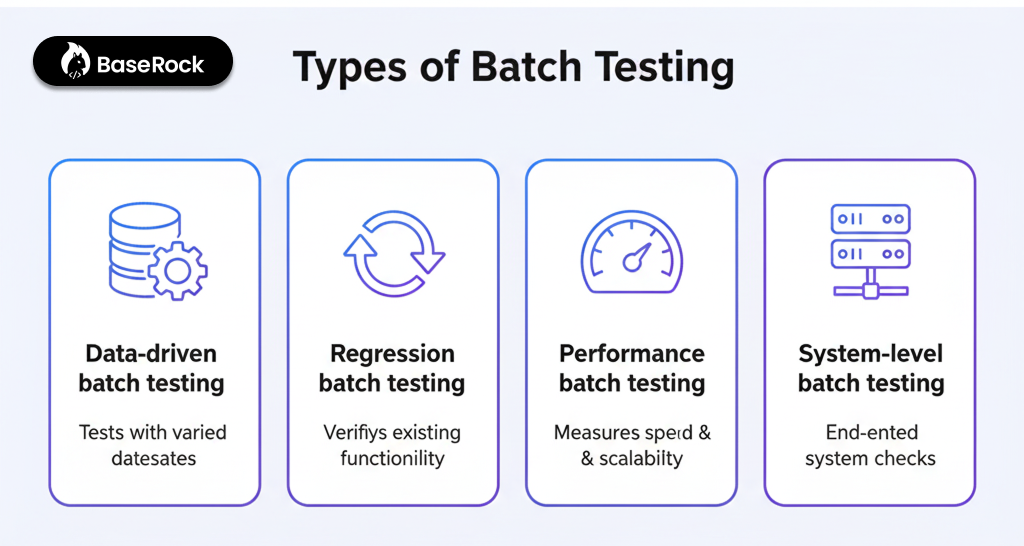
Runs the same test logic across multiple datasets to validate data handling.
Executes a complete regression suite in one batch to ensure new changes don’t break existing functionality.
Tests system behavior under large-scale workloads and prolonged execution.
Validates end-to-end workflows across integrated systems in a single test batch.
Each type of batch testing helps address specific quality and scalability challenges.
Automated batch testing takes batch execution a step further by eliminating manual intervention entirely. Using automation frameworks and CI/CD tools, test batches can be triggered automatically based on schedules, code commits, or release cycles.
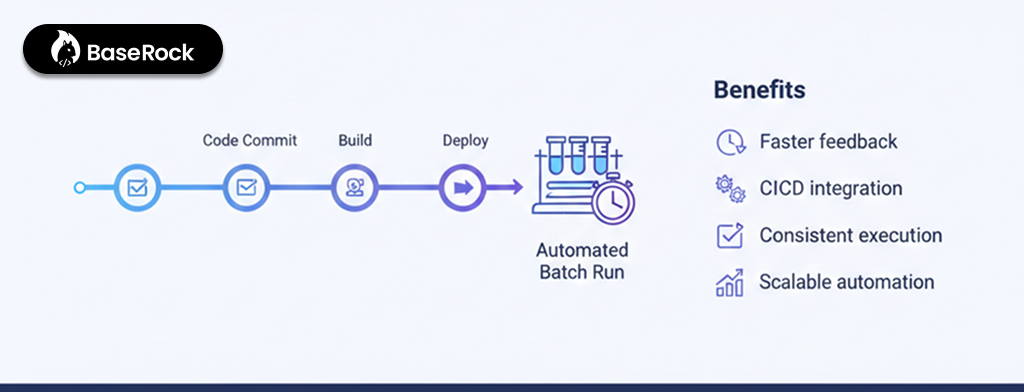
Teams using intelligent automation platforms like BaseRock.ai can streamline batch testing by auto-generating test scripts, managing test data, and analyzing failures with minimal effort.
Batch testing fits naturally into every stage of the software development lifecycle (SDLC):
By integrating batch testing into your workflow, you ensure consistent quality even with frequent updates and fast-paced releases.
Batch testing is a powerful approach for improving efficiency, accuracy, and scalability in software testing. By executing multiple tests together, teams can reduce execution time, minimize errors, and maintain high-quality standards across complex applications.
Whether you’re handling regression suites, backend jobs, or data-heavy systems, batch testing—especially when automated—helps your team test smarter, not harder.
Contact the baseRock.ai software testing team to ensure reliable, scalable, and intelligent batch test execution for your applications.
Get Started with Automated Batch Testing
1.What is batch testing?
Batch testing is a testing method where multiple test cases or datasets are executed together in a single run without user interaction.
2.When should batch testing be performed?
Batch testing is ideal for regression testing, overnight executions, backend jobs, and high-volume data processing scenarios.
3.How is batch testing different from manual testing?
Manual testing runs tests individually with human involvement, while batch testing executes grouped tests automatically or semi-automatically.
4.Can batch testing be automated?
Yes. Automated batch testing uses scripts and tools to run test batches without manual intervention, often integrated into CI/CD pipelines.
5.What are the limitations of batch testing?
Batch testing is not suitable for real-time UI interactions and may require detailed log analysis to identify individual test failures.

Flexible deployment - Self hosted or on BaseRock Cloud

.png)