Open this article in your favorite AI assistant and get key insights instantly.
In today’s fast-paced digital landscape, software teams are under constant pressure to release features faster—without compromising quality. This is where agile software testing becomes a critical enabler. Instead of treating testing as a final phase, agile testing integrates quality checks throughout the development lifecycle, ensuring continuous improvement and faster feedback.
At Baserock.ai, we work closely with agile teams to modernize testing practices using intelligent automation, helping organizations ship reliable software at speed.
What Is Agile Software Testing?
Agile software testing is a continuous, iterative testing approach that aligns with agile development principles. Rather than testing only after development is complete, testing happens alongside coding—within short development cycles called iterations or sprints.
Key characteristics of agile testing include:
Early and continuous testing
Close collaboration between developers, testers, and business stakeholders
Rapid feedback on quality and usability
Flexibility to adapt to changing requirements
In simple terms, if you’re asking what is agile software testing?—it’s about building quality into the product from day one, not inspecting it at the end.
Why Is Agile Software Testing Important?
Agile testing plays a vital role in modern software delivery. Here’s why teams rely on it:
Faster delivery: Continuous testing reduces late-stage surprises and rework.
Improved product quality: Defects are detected early, when they are easier and cheaper to fix.
Better collaboration: Testers, developers, and product owners work as one cross-functional team.
Customer satisfaction: Frequent feedback ensures the product meets real user needs.
By embedding quality into every sprint, agile testing supports rapid innovation without sacrificing reliability.
What Is the Agile Software Testing Life Cycle?
The agile software testing life cycle is iterative and repeats with every sprint. The key stages include:
Test Planning – Identify testing goals, scope, risks, and required tools based on user stories.
Test Design – Create test cases and test data aligned with acceptance criteria.
Test Execution – Run manual and automated tests continuously during development.
Continuous Integration – Integrate code changes frequently and execute automated test suites.
Review & Feedback – Analyze test results, review defects, and share insights with the team.
Iteration & Improvement – Apply feedback in the next sprint to improve both product and process.
This continuous loop ensures quality is maintained even as requirements evolve.
Types of Testing in Agile Software Testing
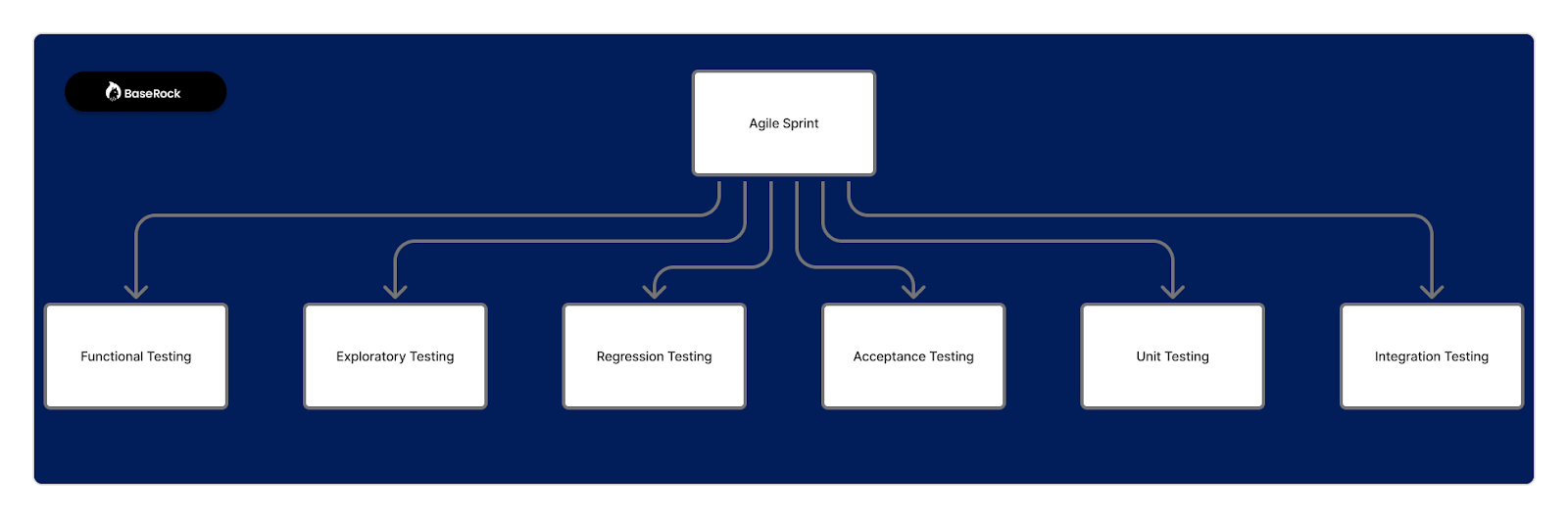
Agile environments rely on multiple testing types, each fitting into iterative workflows:
Functional Testing: Validates features against business requirements and user stories.
Exploratory Testing: Encourages testers to creatively explore the application beyond scripted tests.
Regression Testing: Confirms new changes don’t break existing functionality.
Acceptance Testing: Validates whether the product meets customer and stakeholder expectations.
Unit Testing: Verifies individual components or functions, usually automated by developers.
Integration Testing: Ensures different modules work together correctly.
Together, these testing types support the agile process in software testing by delivering fast and reliable feedback.
Best Practices for Agile Software Testing
To get the most value from agile testing, teams should follow proven best practices:
Involve testers early: Bring QA into requirement discussions and sprint planning.
Automate repetitive tests: Focus manual effort on high-value exploratory testing.
Adopt shift-left testing: Test earlier in the development cycle to reduce defects downstream.
Prioritize user stories: Align testing with business value and risk.
Maintain clear communication: Use daily stand-ups and shared dashboards.
Enable continuous feedback: Leverage CI/CD pipelines for rapid insights.
Modern agile software testing best practices increasingly rely on AI-powered platforms like Baserock.ai to scale automation and reduce maintenance overhead.
Agile Testing Methodologies and Frameworks
Several agile methodologies support effective testing:
Scrum: Testing is embedded in each sprint, with clear acceptance criteria.
Kanban: Continuous testing aligns with continuous delivery workflows.
Extreme Programming (XP): Emphasizes TDD, pair programming, and frequent releases.
BDD/TDD: Test-Driven Development and Behavior-Driven Development ensure code meets expectations from the start.
Frameworks and agile testing software tools—especially AI-driven solutions—enhance collaboration, speed up test creation, and improve coverage.
How to Implement Agile Software Testing in Your Organization
Adopting agile testing requires both cultural and technical changes. Here’s a practical roadmap:
Train cross-functional teams on agile principles and testing strategies.
Choose the right tools for test management, automation, and CI/CD.
Integrate automation early to support fast feedback loops.
Redefine workflows so testing runs in parallel with development.
Foster collaboration between QA, development, and product teams.
Set up CI pipelines for continuous integration and testing.
Platforms like Baserock.aihelp organizations accelerate this transition by using AI to generate, maintain, and optimize tests—freeing teams to focus on innovation.
Streamline Your Agile Testing with Baserock.ai
Streamline Your Agile Testing with Baserock.ai – Start Your Free Trial Today.
Frequently Asked Questions (FAQ)
1. What is the difference between agile testing and traditional testing?
Agile testing is continuous and iterative, while traditional testing typically occurs after development is complete in a separate phase.
2. What are the 4 levels of agile testing?
They are unit testing, integration testing, system testing, and acceptance testing—executed continuously across sprints.
3. What tools are best for agile software testing?
Popular tools include automation frameworks, CI/CD platforms, and AI-driven solutions like Baserock.ai for scalable agile testing.
4. How do you implement test automation in agile?
Start by automating high-priority regression tests, integrate them into CI pipelines, and continuously refine coverage sprint by sprint.


.jpg)